Choosing a Maine State Park Campground by Setting, Size and Amenities
Choosing a Maine State Park campground can feel harder than choosing a destination: the right site depends on the setting you want, the space your tent or vehicle needs, and the amenities that matter to your group. A useful approach is to compare those needs before you focus on a particular park, then confirm the details on the official campground map and reservation listing.
Start with the kind of trip you want
A campground can be a place to sleep, a base for exploring, or a destination in its own right. Decide which role matters most before comparing individual parks. That helps separate must-haves from nice-to-haves, especially when a campground looks appealing but doesn’t match the way you plan to spend your time.
The Maine Department of Agriculture, Conservation and Forestry lists 12 State Parks for campsite searches; according to its Bureau of Parks and Lands, camping is offered at 12 State Parks. The names listed for campsite searches are Aroostook, Bradbury Mountain, Camden Hills, Cobscook Bay, Lake St. George, Lamoine, Lily Bay, Mount Blue, Peaks-Kenny, Rangeley Lake, Sebago Lake, and Warren Island.
The Maine Department of Agriculture, Conservation and Forestry, Bureau of Parks and Lands, describes camping opportunities as 12 State Park Campgrounds ● The Allagash Wilderness Waterway, and also lists the Penobscot River Corridor and public lands backcountry sites. That wider range can help put state park camping in context, but this comparison focuses on choosing among the state park campgrounds.
Choose a setting before choosing a park
Start with the scenery and activities you hope to have nearby. You might be picturing a waterside stay, a wooded campsite, a beach day, a hike, or a campground that works as a convenient base for visiting other places. Those ideas are useful starting points, but don’t assume a park name or a broad landscape description guarantees a particular campsite view, activity, or facility.
Instead, make a short setting checklist:
- What would you like to see from the campsite, if anything?
- Do you want to spend most of the trip at the campground, or leave for outings?
- Is proximity to a beach, lake, trail, or other feature central to your plans?
- Would a busy recreation area suit your group, or would you rather prioritize a quieter-feeling site?
- Are you comfortable with a walk from the campsite to the activity you care about?
Then use the park information and campground map to confirm what is actually available. A campground may be near the kind of feature you want without every site being close to it. Site location matters as much as the general setting, so look for the specific loop or campsite position rather than relying only on a park-wide description.
If you’re still deciding between a lakeside and coastal trip, Lake Parks or Coastal Parks? Picking Your Maine Campground Setting can help you think through which landscape suits your plans. For a broader overview of the range of destinations, see Camping in Maine State Parks: Campground Choices, Openings and Rules.
Match the setting to your trip rhythm
A stay built around a single activity calls for different priorities than a trip where the campground is mainly a place to return to at night. If swimming or beach time is the main draw, consider how you’ll get from your campsite to the swimming area and whether the park’s current information confirms access that suits your group. If you’re planning hikes or other outings, check the map and park information for the routes and access points you intend to use.
A park can also work well as a home base even when you expect to spend much of the day elsewhere. In that case, focus on practical campsite needs: room for your sleeping setup, access to the facilities you require, and a location that makes arrival and departure manageable. The park’s overall setting still matters, but it may not need to be the main deciding factor.
Don’t treat “near the water” or “wooded” as a promise about privacy, shade, or views. Those details can vary from site to site. Use the campground map to narrow the location, then read the site description and confirm any important detail through the official information before making plans.
Size means both campground scale and site fit
“Size” can refer to the overall feel of a campground or to the physical space available at an individual campsite. Those are related but different questions. A campground with many sites may offer more choice across loops, while a smaller campground might feel simpler to navigate; neither description tells you whether a particular campsite will fit your tent, RV, or group comfortably.
The campground map is the best starting point for understanding layout. Look at how the sites are arranged, where the entrance and shared facilities appear, and whether the site you’re considering is near a road, a path, or a central area. A map can also help you spot differences between loops, though it may not show every detail that affects comfort.
For help comparing campground scale, see Small or Large? Comparing Maine State Park Campground Sizes. If your main question is how much room a particular site can offer, Reading a Maine State Park Campground Map Before You Pick a Site and What S, M, L, X and U Mean on Maine Campground Maps are useful next reads.
Check the footprint, not just the label
Before booking, compare the listed site size or category with the gear you’ll bring. Consider the footprint of the complete setup, not just the tent or vehicle by itself. That might include a tow vehicle, trailer, awning, extra shelter, or the space needed to move around safely. Don’t assume a site category alone answers whether your setup will fit; read the listing and map carefully.
For a tent, think about the actual ground area your shelter needs, including stakes and any vestibule or rain cover that extends beyond the main sleeping area. A site that looks generous on a diagram may have a usable area shaped by trees, slopes, rocks, or nearby features. If the ground shape is important, seek details about that specific campsite rather than relying only on a general campground image.
For an RV or trailer, check the site’s listed dimensions and layout, and account for the full parked arrangement. The vehicle, trailer, and any equipment that needs to sit beside them all take space. If the measurements or site description leave room for doubt, confirm the fit with the official reservation information before choosing.
The same caution applies when camping with another party. Two nearby sites may make coordination easier, but proximity on a map does not guarantee a shared feel or a direct connection. If being close to another group is important, check the exact site locations and descriptions. For a larger gathering, compare ordinary campsites with the options discussed in Group Camping at Maine State Parks: Who Qualifies and What It Costs.
Think about the feel you want around the site
The layout can affect how a campsite feels as much as its dimensions. A site beside a busy route may be convenient but less sheltered from passing people or vehicles. A site farther from shared facilities may offer a different trade-off: more walking in exchange for a location that better fits your preferences. These are not guarantees about any particular campground; they are reasons to inspect the map and site description instead of choosing by name alone.
If privacy is high on your list, look at the spaces between site markers and the shape of the loop. A map may suggest where sites sit relative to each other, but it cannot fully show sightlines or vegetation. Read descriptions for details and keep expectations flexible. A campsite is part of a shared campground, so a secluded appearance on a map is not a promise of solitude.
For campers who need a clear route to restrooms or other facilities, proximity may matter more than privacy. Consider who is in your party, how often they may need to walk back and forth, and whether the path or terrain could be a concern. Make the trade-off deliberately rather than selecting a site solely because it appears attractive in a listing.
Compare amenities by how you’ll use them
Amenities are valuable when they solve a real need. A long list of possible conveniences can be distracting if most won’t affect your trip. Start by sorting what you need into essentials, helpful extras, and features you can do without. Then confirm the details for the park and site you are considering.
| Priority | What to verify | Why it matters |
|---|---|---|
| Sleeping setup | Space and surface that suit your tent, vehicle, or trailer | A site must work for the gear you actually bring |
| Water | Where drinking water is available and whether access meets your needs | Availability and location affect daily routines |
| Restrooms | The type, location, and accessibility described by the campground | Walking distance and facility type may shape comfort |
| Showers | Whether the campground information lists them and where they are located | A facility elsewhere in the park may not be convenient from every site |
| Power | Whether the specific site listing confirms the connection you need | Don’t assume power is available at every campsite |
| Waste services | Where the map or listing identifies disposal options | Useful when planning a longer stay or traveling in an RV |
| Recreation access | Routes or paths to the activity you came for | A nearby feature may still require a walk or drive |
| Site shade or cover | What the site description and map indicate | Helpful for comfort, but descriptions may not guarantee conditions |
Treat each line as something to check, not something every campground or campsite provides. Park-wide amenities, campground amenities, and individual-site features are not interchangeable. A facility shown in a park overview might be a distance from the site you book, and a general campground amenity does not necessarily mean it is available at every site.
Separate essentials from conveniences
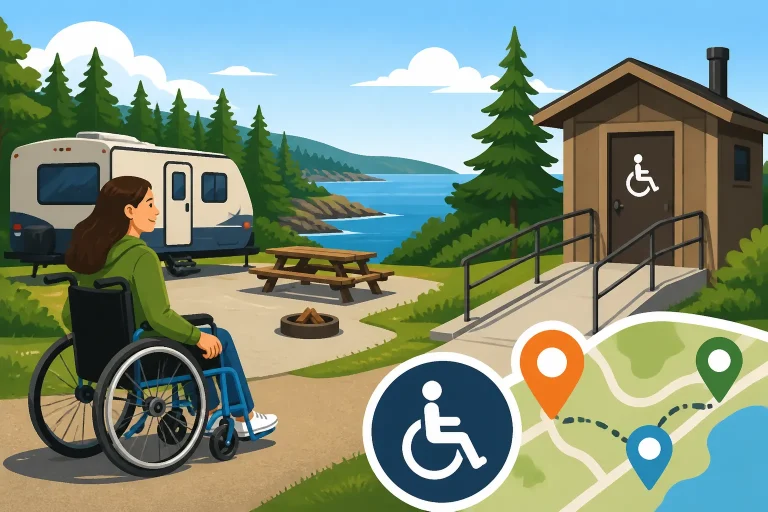
Write down the facilities you genuinely need before searching. For example, a camper relying on a particular kind of electrical connection should verify that the selected site listing confirms it. A visitor who needs an accessible route should check the relevant park and site details rather than guessing from a map symbol. Someone who doesn’t need those features can avoid letting them dominate the comparison.
This is also a good way to keep the trip within your comfort zone. If you are happy to carry supplies farther, a site’s location relative to services may be less important. If you’re camping with young children, older relatives, or someone with mobility needs, convenience and route details may matter more. The best campground is the one whose actual services and layout support the group you’re bringing.
For a closer look at amenities that commonly affect choices, see Which Maine State Park Campgrounds Have Hot Showers? and Water and Electric Hookups at Maine State Parks, Park by Park. Use those topics as prompts for what to verify; confirm the current details for the specific campground and site before you rely on them.
Don’t confuse a park feature with a campsite feature
A park might offer an activity or shared facility without that feature being right beside your campsite. Likewise, a campground may have a facility that is not open or available in every season. Read the campground details together with the park information and check any current notices that could affect your visit.
This distinction matters most when a facility is essential. If you need a particular service, confirm both that it is offered and where it is relative to the site. If it’s merely a convenience, decide whether the extra walk or a different routine would be acceptable. A precise question is easier to verify than a broad one: “Does the selected site have the connection I need?” is more useful than “Does the park have hookups?”
Use a map and site listing together
A campground map helps you understand relationships between places; a site listing helps you evaluate a specific campsite. Neither is enough by itself. The map can show where a site sits in a loop, while its listing may describe the site type or size. Compare both before deciding, and use official information to clear up anything that affects your plans.
The Maine Department of Agriculture, Conservation and Forestry, Bureau of Parks and Lands, advises visitors to view available sites for different dates: there is no fixed alternate-campground list tied to a full site, so visitors can search the other Maine State Park campgrounds—Aroostook, Bradbury Mountain, Camden Hills, Cobscook Bay, Lake St. George, Lamoine, Lily Bay, Mount Blue, Peaks-Kenny, Rangeley Lake, Sebago Lake, and Warren Island—in the official reservation system by park and arrival date; public lands backcountry camping is another option, but remote sites are generally first-come, first-served, so there is no general reservation availability check for them.
Read the map for practical details
When you inspect the campground map, look beyond the shape of the loop. Notice the relationship between the site and the entrance, shared facilities, nearby roads, and paths. Ask whether the route you’d take each day seems workable for your group. A site that appears attractive may be less convenient than another if it creates a daily walk you didn’t plan for.
Maps vary in how much detail they show. Some may not make slope, vegetation, or exact distances easy to judge. If those details are important, use the map as a starting point and look for a more specific description or current campground information. Don’t infer a guarantee from a symbol or a short site label.
If a site choice turns on a detail the map cannot answer, contact the agency using current contact information on its official website. Be specific about the campsite and the question. For example, ask about the dimensions or location of a particular site rather than requesting a general description of the whole campground.
Check the site listing for the details the map leaves out
The reservation listing may clarify the site type, size, or other features that are not obvious from the map. Read the complete description, not just the first line or category. If the listing includes a limitation or an important note, weigh that against your setup before moving on to the next step.
For a tent, compare the listed footprint with the shelter you plan to pitch. For an RV or trailer, make sure the full arrangement is appropriate for the space. If the listing doesn’t answer the question you care about, don’t assume the answer is favorable. Seek clarification or choose a site whose description is more conclusive.
It can help to keep a short note for each candidate site: location, fit, essential amenities, and any unknowns. That makes it easier to compare sites without reopening every page and helps you spot a promising option that still needs confirmation.
Build a shortlist around real trade-offs
A useful shortlist should include sites that meet your essential needs, not merely the sites that look appealing at first glance. Start with the trip setting, rule out options that cannot fit your equipment or group, and then compare amenities and location. If a site misses a true necessity, don’t keep it on the list just because you like the park name.
| Your main priority | Focus your comparison on | Trade-off to consider |
|---|---|---|
| A particular landscape or activity | Park setting, activity access, and site location | A park-wide feature may not be close to the campsite |
| A tent setup | Site footprint, surface, and room around the shelter | A category may not show every ground-level obstacle |
| An RV or trailer | Listed site dimensions and the complete parked setup | A site’s label alone may not establish fit |
| Convenient facilities | Locations of the facilities you’ll use most | A campground amenity may require a walk from your site |
| A quieter-feeling location | Site position, nearby roads, and spacing on the map | Maps can’t guarantee privacy or low activity |
| A group stay | Site arrangement, capacity details, and group options | Nearby sites may not function like a shared group area |
| Flexible dates | Availability across different arrival dates and parks | A first-choice campground may not have an open site |
Treat the table as a way to organize questions, not a scorecard that can identify a perfect campground from the park name alone. Two groups can look at the same location and make different choices because their needs differ. One may prefer an easy route to facilities; another may accept a longer walk for a site location that better suits the trip.
Rank the factors that can’t be compromised
Mark essential needs first. These may include a site that fits your setup, a facility you depend on, a route that works for someone in your group, or an activity that makes the destination worthwhile. Once those are clear, rank the remaining preferences. This prevents a minor convenience from outweighing a practical requirement.
Next, identify the trade-offs you’re willing to accept. Perhaps you would choose a less convenient location if it better fits your setting preference. Perhaps you’d rather prioritize the site layout over proximity to a shared facility. Deciding in advance makes it easier to compare options consistently.
A short list can also help if your first choice is unavailable. Keep alternatives that satisfy the essentials, even if they are not identical in setting or amenities. A backup that meets the practical needs of the trip is usually more useful than a list of parks selected only by reputation or name.
Check availability only after defining what fits
Searching before you know what you need can lead to choosing an open site that doesn’t work for your equipment or group. Set your requirements first, then compare availability and adjust only where a trade-off is acceptable. If the first date or campground doesn’t work, consider other dates or parks rather than assuming there is a fixed backup list.
For general booking steps and campground choices, use CampWithME Explained: Accounts, Searches and Booking a Maine Campsite. For the wider picture of campground openings and planning, see Campground Seasons Across Maine State Parks: Opening to Closing. Availability and seasonal details can change, so confirm them in the official reservation system and current park information before traveling.
Make the final choice with a simple check
When you have a likely campsite, pause before committing and review the details as a set. The setting should suit the trip, the site should fit your sleeping arrangement and equipment, and the listed amenities should cover your real needs. If any of those points remain unclear, resolve the uncertainty before treating the site as a match.
Use this decision sequence:
- Describe the trip in a sentence: what you want to do and what kind of setting you hope for.
- Write down the equipment and people the campsite must accommodate.
- Identify essential amenities and the location details that matter.
- Compare park information, campground maps, and individual site listings.
- Remove options that fail a non-negotiable requirement.
- Compare the remaining sites by the trade-offs you are willing to make.
- Confirm current availability, seasonal information, and any unresolved site detail through official information.
The sequence keeps preference and practicality in balance. A beautiful setting cannot make an undersized site work, and a convenient amenity does not necessarily justify a location that misses the point of your trip. Conversely, the most spacious or feature-rich option is not automatically the best choice if your group won’t use those advantages.
Consider the arrival and daily routine
Picture the campsite as you will use it, not only as it looks in a listing. Think about where you’ll unload, set up, cook, and store equipment. Consider how often you may walk to shared facilities and whether a route or distance could make the stay less comfortable. These practical details can matter more over the course of a visit than a feature that sounded appealing during the initial search.
For an RV, include the tow vehicle or other parts of the setup when assessing space and movement. For a tent, think about how much ground you need beyond the sleeping area. For a group, consider whether the site layout supports the way you expect to gather. The goal is not to predict every inconvenience; it is to catch obvious mismatches before arrival.
If your plans depend on access to a particular park feature, confirm that access using current official information. Conditions, services, and availability can vary. A campground page or map can help you plan, but it should not replace a current check when a change would affect the trip.
Keep a backup that still works
A backup plan is most useful when it reflects your actual priorities. If you need a specific kind of site, don’t treat any open campsite as an equivalent substitute. Identify what can change—dates, location, or a convenience—and what cannot, such as equipment fit or a necessary amenity.
If the first campground is full, search other state park campgrounds by park and arrival date in the official reservation system. For public lands backcountry camping, understand that remote sites are generally first-come, first-served and do not have a general reservation availability check. Those options involve different planning assumptions, so don’t count on seeing the same kind of live site availability.
For more context on choosing among the available campgrounds, see How Many State Parks Does Maine Have, and Which Offer Camping?. Keep your shortlist focused: an option belongs on it only if it could reasonably work for your group.
Frequently Asked Questions
How do I choose between two Maine state park campgrounds?
Compare the trip setting you want, the fit of the specific site, and the amenities you’ll actually use. Look at the campground map and individual listings together, then choose based on your essential needs and acceptable trade-offs.
Does the park name tell me what a campsite will be like?
Not reliably. Use the official campground map and the individual site description to check location, fit, and listed features. Confirm anything important that those materials do not make clear.
What should I check before choosing an RV or tent site?
For a tent, compare the site’s listed size and description with your shelter’s full footprint. For an RV or trailer, check the listed dimensions against the complete setup, including any vehicle or equipment that needs to occupy the site.
What can I do if my preferred campground is full?
Search other Maine State Park campgrounds and arrival dates in the official reservation system. If considering public lands backcountry camping, plan for its different availability approach: remote sites are generally first-come, first-served.
Sources
- Maine Department of Agriculture, Conservation and Forestry — Camping Reservation Tips/FAQ: State Parks and Public Lands: Maine DACF (checked November 23, 2026)
- Maine Department of Agriculture, Conservation and Forestry, Bureau of Parks and Lands — outdoors-in-maine.pdf?utm_source=openai (checked November 23, 2026)
- Maine Department of Agriculture, Conservation and Forestry, Bureau of Parks and Lands — State Parks: About Us: Bureau of Parks and Lands: Maine DACF (checked November 23, 2026)
Disclaimer
This article is for general informational purposes only and does not constitute professional advice. Laws, prices and regulations vary by location and change over time. Consult a qualified professional for guidance on your specific situation. Maine Camping & RV is not a government agency and is not affiliated with any government agency.