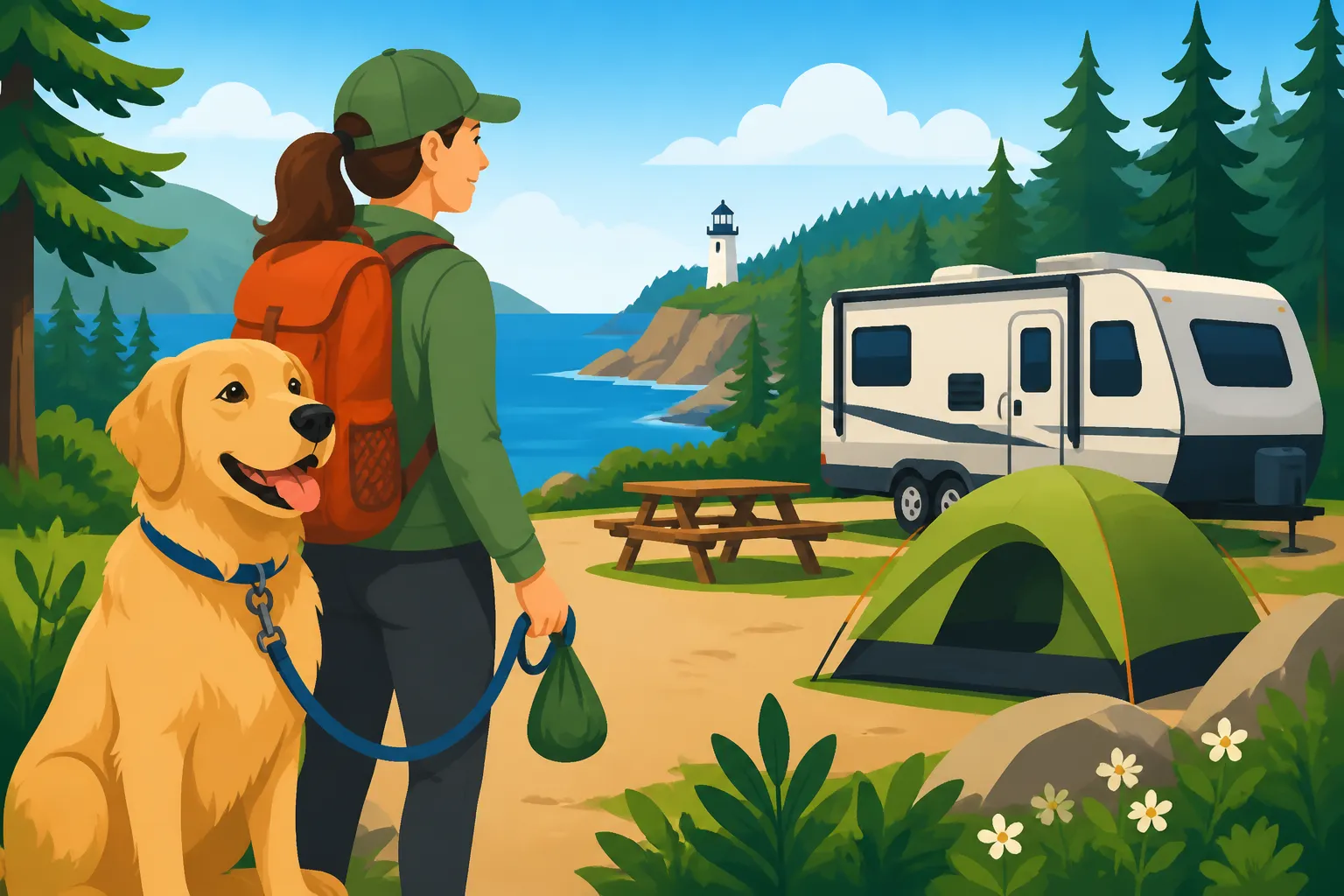
Pets in Maine State Parks: Campground Access, Leashes and Pet Waste
Bringing a pet camping can make a Maine state park trip more enjoyable, but it also affects which campground you can choose and how you manage your animal around other campers. The key is to plan around the access exception, keep your pet leashed and under control, and handle waste promptly. Here’s how to apply those requirements before you leave and throughout your stay.
Start with the campground access rule
According to the Maine Department of Agriculture, Conservation and Forestry, pets are allowed at all campgrounds except Sebago Lake State Park Campground and must be leashed, controlled, and not left unattended.
That rule gives you the first decision to make: confirm that the campground you are considering allows pets before you plan a trip around it. The exception is specific to the Sebago Lake State Park Campground. Do not assume that a pet is allowed there because you have brought one to another Maine state park campground, or assume that a rule for the campground settles every question about other areas of a park. Check the official information for the park and the part of the property you plan to visit.
If you are still choosing a destination, begin with the campground rather than selecting a park first and sorting out pet access later. The overview in Camping in Maine State Parks: Campground Choices, Openings and Rules can help you compare campground options and understand what to check before making a plan. If your first choice does not suit your pet or travel setup, look for another campground that does.
The access rule also gives a useful framework for thinking about the trip: permission to camp with a pet is not permission to let the pet roam or remain unattended. Leash, control, and supervision are part of making a pet-inclusive campsite work. A good plan accounts for all of them, rather than treating access as the only requirement.
| Camping question | What to plan around |
|---|---|
| Is a pet allowed at the campground? | Confirm the specific campground. The Sebago Lake State Park Campground is the stated exception. |
| How should a pet be managed? | Keep it leashed and under control. |
| Can a pet be left alone at camp? | No. Plan for continuous supervision rather than leaving the animal unattended. |
| What happens to pet waste? | Pick it up promptly and dispose of it properly. |
| What if a trip includes another park area? | Check the official information for that area instead of assuming campground access answers every access question. |
A pet-friendly campground is a better fit when its basic conditions also fit your animal. Consider whether your pet is comfortable sleeping outdoors or in your chosen shelter, reacting to unfamiliar sounds, and sharing a busy setting with nearby campers. A campground can permit pets while still being a poor match for an animal that becomes distressed around people, wildlife, traffic, or other animals.
It is also worth checking practical details before you commit. Look at the campground map and information for the specific site you are considering, and confirm that the site and its surroundings are workable for your pet. If a detail is not clear, ask the park through its official contact channels before departure. The goal is not to assume extra restrictions; it is to avoid arriving with an unanswered question that changes how you can use your reserved site.
Choose a campground with your pet in mind
Choosing a campground with a pet involves more than checking whether pets are allowed. Think about the kind of setting your animal handles well, the amount of activity you expect around camp, and how you will meet the pet’s everyday needs without leaving it unattended.
A quiet, low-traffic-feeling site may be more comfortable for an animal that startles easily, while an outgoing pet may cope better with a busier campground. These are planning considerations, not a guarantee that a particular site will be secluded or quiet. Campground conditions can change with the mix of visitors, activity, and weather. If you need a particular site feature, verify it with the official campground information instead of relying on a general description.
The campground map can help you look for the practical layout that will make pet care easier. Consider how much space is shown around a site, what route you would take to reach the facilities you expect to use, and whether the site appears to be close to a road or shared activity area. A map cannot tell you how your animal will react to every sound or encounter, but it can help you ask more useful questions before you arrive. For help interpreting site layouts, see Reading a Maine State Park Campground Map Before You Pick a Site.
Your pet’s needs matter as much as the map. Think through sleeping arrangements, feeding, water, exercise, and what you will do if the animal is uncomfortable. A pet that is used to a quiet home may find a campground’s unfamiliar noises difficult. An animal that is accustomed to travel may still need time to settle into a new environment. Plan for a gradual, supervised introduction to the site rather than expecting the pet to adapt immediately.
A practical campground comparison can include questions such as:
- Does the campground allow pets, and have you confirmed the answer for the specific campground?
- Is the site arrangement workable for keeping your pet leashed and under control?
- Can you keep the animal supervised while you cook, unpack, or use campground facilities?
- Does the site seem suitable for your pet’s size, temperament, and usual sleeping setup?
- Do you have a plan for managing the pet if the campground is busier or noisier than expected?
- Have you checked the official information for any additional details relevant to your visit?
These questions do not establish new rules. They help you decide whether the trip is practical for your household and your animal. If the answer to a key question is uncertain, ask before you go or choose a different campground. A pet’s comfort and the needs of nearby campers are easier to manage when the site is a reasonable fit from the start.
The broader campground overview in Choosing a Maine State Park Campground by Setting, Size and Amenities can help you compare settings. For a more general picture of site rules, see Maine State Park Campground Rules: Occupancy, Vehicles and Waste. Keep pet-specific requirements in view while using those resources: your site choice still needs to support leashing, control, supervision, and prompt waste cleanup.
Season can also affect how manageable a pet trip feels. Weather, daylight, and available campground services can influence how long your animal is comfortable outside and how you organize daily care. Before settling on dates, check the campground’s operating information and any current notices. Campground Seasons Across Maine State Parks: Opening to Closing is a useful starting point for understanding why timing belongs in the planning process.
If your pet has a health condition, a history of anxiety, or difficulty being around other animals, consider whether a shared campground is appropriate. Talk with a qualified veterinary professional about health and travel questions, and be realistic about what you can supervise. A pet that needs a calm environment or frequent attention may be better served by a different kind of outing. The access rule tells you whether a campground permits pets; it cannot tell you whether your particular pet will be comfortable there.
Keep your pet leashed and under control
Leashing and control are separate parts of responsible pet management. A leash helps keep an animal close and prevents it from approaching people or other animals without your direction. Control means staying attentive to the pet and responding before a situation becomes difficult. A leash by itself is not a substitute for supervision.
Use the leash whenever you are managing your pet around the campground, and hold or secure it in a way that lets you guide the animal. Avoid letting a pet wander out of reach or treating a long lead as a reason to stop paying attention. A pet can still reach a nearby site, person, animal, or shared space if the handler is distracted or the leash is not managed carefully.
The specific leash length is not stated in the access rule described above. If you need to know whether a particular leash or setup is acceptable, confirm the current requirement with the official park information. How Long Can a Dog Leash Be at Maine State Park Campgrounds? addresses that narrower question; do not guess at a maximum length or assume a product’s label determines what the campground accepts.
Control also means paying attention to what your pet is doing. Watch for signs that it is becoming overstimulated, frightened, uncomfortable, or too interested in someone else’s campsite. A pet that seems relaxed at home may respond differently to unfamiliar voices, cooking smells, footsteps, or other animals. Give it space and redirect it before it approaches another camper or becomes difficult to manage.
A few habits can make this easier:
- Keep the leash in hand when moving around camp rather than allowing the pet to lead you toward other sites.
- Choose a position where you can see the animal while you are sitting or doing a task.
- Keep children and other members of your party clear about who is supervising the pet.
- Give the animal time to settle instead of encouraging introductions with people or pets nearby.
- Move away from a situation that is making your pet anxious or difficult to control.
- Check that the leash and collar or harness are secure before you leave the site.
These are practical ways to meet the requirement to keep a pet leashed and controlled; they are not additional park rules. Choose equipment your pet is accustomed to and that you can manage reliably. A nervous animal may pull, slip out of poorly fitted gear, or react suddenly. If you are unsure whether your usual setup is secure, address that before the trip.
Think about leash handling during ordinary campground tasks, too. Carrying supplies, opening a vehicle, or setting up camp can divide your attention. Arrange those tasks so someone remains responsible for the pet, or keep the animal secured and supervised while you work. Do not assume that a momentary distraction is harmless simply because the pet has stayed close in the past.
Other campers may have different comfort levels around animals. Some may be uneasy, and some may be managing their own pets or children. Keeping your animal close and under control helps avoid unwanted approaches and makes shared spaces easier for everyone to use. If another camper asks for room, create distance rather than expecting them to interact with your pet.
For situations that may be especially busy, Keeping a Dog Under Control at a Busy Maine State Park Campsite offers further planning help. For questions about whether pets are welcome beyond the campground, see Are Leashed Dogs Welcome on Maine State Park Trails and Picnic Areas?. Do not treat campground permission as automatic permission for every park location; check the official information for the area you intend to visit.
Plan for continuous supervision
The requirement not to leave a pet unattended should shape your daily plan, not just your campsite setup. Consider how you will handle activities that take you away from camp, including errands within the park, shared facilities, or outings where the animal cannot come along. If you do not have a reliable supervision plan, reconsider the activity or the trip.
A pet left alone may become distressed, bark, pull at its restraint, or react to people and animals passing by. Even a pet that is normally calm can respond differently in an unfamiliar setting. More importantly, leaving it unattended does not meet the stated requirement. A crate, vehicle, tent, or other enclosure should not be treated as a way around that requirement.
If you are camping with other people, decide who is responsible for the pet during each part of the day. Make that arrangement clear rather than assuming someone else is watching. If the person supervising needs to step away, another responsible person should take over. This simple handoff can prevent the pet from being overlooked while everyone is busy.
If you are camping alone, think through the supervision issue before departure. Identify the activities that may be difficult with your pet present and decide whether you can manage them without leaving it behind. Do not rely on the hope that someone at the campground will be available to help. Another camper is not a substitute for your own plan or responsibility.
A pet’s comfort is part of this decision. If the animal is unable to settle, is showing signs of distress, or is reacting strongly to the setting, consider changing your plans. Continuing with the trip while hoping the pet will adjust may make the experience harder for the animal and the people nearby. Take a break from activity, create distance from the trigger, or end the outing if that is the safer choice.
The article A Dog Left in the Tent: Maine State Parks’ Unattended-Pet Rule looks more closely at this issue. The important planning point is straightforward: do not build an itinerary that depends on leaving your pet alone at camp. If an activity requires you to be away, arrange suitable supervision or choose an activity that works with your pet.
For a shared campsite, it can help to agree on a simple routine before arrival. Decide who holds the leash during setup, who handles feeding, and who stays with the pet when someone steps away. Keep the routine flexible enough to respond to the animal’s behavior, but clear enough that responsibility is never assumed to have passed to someone else.
If your group includes children, explain that the pet needs an attentive adult or responsible handler. Children may enjoy helping, but they should not be expected to manage a situation they cannot control. Make sure everyone knows not to open a gate, release a leash, or invite an unfamiliar person or animal to approach without the handler’s direction.
Unattended-pet planning also affects what you pack. Bring the ordinary supplies that make it easier to stay with your animal and keep it settled, such as food, water, familiar bedding, and equipment you already know how to use. Do not rely on an enclosure as permission to leave the animal alone. The purpose of preparation is to support supervision and comfort, not replace them.
Pick up and dispose of pet waste properly
According to the Maine Department of Agriculture, Conservation and Forestry, pet waste must be picked up immediately and disposed of properly.
Treat cleanup as part of every walk and every visit outside your site. Carry waste bags before you need them, keep them accessible, and pick up waste when it happens rather than planning to return later. If you are managing the leash at the same time, prepare the bag in advance so you can respond without losing control of the pet.
After picking up the waste, dispose of it properly. Do not leave a filled bag at the site, along a route, or beside a shared area. Do not assume that someone else will remove it. Check the campground’s official information for the appropriate disposal arrangements, and follow any posted directions. If you are unsure where a bag belongs, ask park staff or use the official contact information to confirm.
A useful routine is to prepare before leaving your site:
- Put waste bags where you can reach them while holding the leash.
- Bring a way to carry a used bag until you reach the proper disposal option.
- Check that you have supplies before each outing, not just when you first arrive.
- Keep a separate place for used bags so they do not mix with clean supplies.
- Follow posted directions for disposal rather than choosing a convenient but uncertain location.
These are practical habits for meeting the waste requirement, not a substitute for posted directions. The campground may provide information about disposal that you should check when you arrive. If the nearest option is not obvious, ask rather than leaving a bag where it may be missed or cause a problem.
Prompt cleanup matters beyond appearance. Waste left behind can affect other campers’ use of a site or path, and it can create an unpleasant experience for people who come after you. A tidy campsite also makes it easier to notice whether you have left anything behind when you pack up. Good waste habits are a small task repeated throughout the visit, not a single chore at departure.
Do not assume that waste can be buried, left in vegetation, or placed in an unmarked area. If you do not know whether a disposal method is acceptable, use the campground’s official directions. The safest approach is to carry the waste until you can dispose of it as directed, rather than making a guess.
The article Picking Up After Your Dog at Maine State Parks: What’s Required focuses on the cleanup question. For other campground expectations that may affect how you keep a site tidy, see Maine State Park Campground Rules: Occupancy, Vehicles and Waste. Keep the pet-waste requirement distinct from general trash handling: one does not automatically answer the other.
Prepare before you leave and check again on arrival
A pet-inclusive trip is easier when you settle the basic questions before packing. Confirm that the chosen campground permits pets, review the official park information for your intended location, and check for current notices that could affect your plans. If something is unclear, ask the park through its official channels before departure. Do not depend on an old recollection or a general description when the detail matters to your trip.
Pack for supervision, comfort, and cleanup. Bring your pet’s usual food, water, leash, collar or harness, bedding, and waste bags, along with any other supplies your animal needs. Familiar items can help make an unfamiliar site less stressful, but they do not remove the need to keep the pet leashed, controlled, and supervised. Pack what allows you to care for the animal without relying on other campers.
Before leaving home, consider the trip from your pet’s perspective. How does it handle the travel itself? Is it comfortable in the shelter you intend to use? Does it respond calmly to unfamiliar sounds and nearby activity? Can you maintain its usual care routine at the campground? If the answer to any of these is uncertain, adjust the plan or seek appropriate professional advice before traveling.
When you arrive, take a moment to orient yourself. Review posted information, identify the relevant disposal directions, and make sure the site setup lets you keep the pet close. Check your equipment and agree on who is responsible for the animal. If the site presents a problem you did not anticipate, contact park staff for clarification rather than assuming that a workaround is allowed.
A simple arrival routine can include:
- Confirming posted directions and any information relevant to pets.
- Checking that the leash, collar, or harness fits and works as expected.
- Selecting a place for food and pet supplies that keeps the site organized.
- Establishing who is supervising the pet while camp is set up.
- Locating or asking about the proper way to dispose of pet waste.
- Giving the animal time to settle before taking on more activity.
The point of this routine is not to create extra regulations. It is to make sure the basics are in place before distractions and campground activity build. If you discover that a key detail differs from what you expected, pause and confirm the appropriate next step with the park.
During the stay, keep checking whether the plan is working. A site that felt manageable at arrival may become busier, or a pet may react differently after spending time in the new environment. Adjust by creating space, keeping a closer hold on the leash, or reducing activity. If the animal cannot settle or you cannot maintain supervision, do not treat that as a minor inconvenience to ignore.
At departure, check the site for waste bags, pet supplies, food, and any equipment you brought. Leave the area tidy and take your belongings with you. If you are uncertain about how to handle something you found or any remaining waste, follow the campground’s posted guidance or ask park staff.
For broader preparation, Packing for a First Maine State Park Campout can help with general camping supplies, while Your First Night at a Maine State Park Campground: What to Expect can help you plan for the arrival and overnight routine. Use those resources alongside the pet-specific requirements, not in place of them.
Frequently Asked Questions
Are pets allowed at every Maine state park campground?
No. The Sebago Lake State Park Campground is the stated campground exception. Confirm the rules for the specific campground you plan to use before you travel.
Does my pet need to stay on a leash at camp?
Yes. Plan to keep your pet leashed and under control throughout your campground stay. Check official information if you need clarification about a particular leash setup.
Can I leave my pet in a tent while I step away?
No. The campground rule requires pets not to be left unattended. Arrange for someone to stay with the pet or change your plans so the animal remains supervised.
Where should I put pet waste?
Pick it up right away and use the disposal method identified by the campground. If directions are not clear, ask park staff rather than leaving a bag or placing it somewhere uncertain.
Sources
- Maine Department of Agriculture, Conservation and Forestry — Camping Reservation Tips/FAQ: State Parks and Public Lands: Maine DACF (checked November 23, 2026)
Disclaimer
This article is for general informational purposes only and does not constitute professional advice. Laws, prices and regulations vary by location and change over time. Consult a qualified professional for guidance on your specific situation. Maine Camping & RV is not a government agency and is not affiliated with any government agency.