Accessible Visits to Maine State Parks: Sites, Privies and Maps
A state park can be beautiful and still be difficult to use if the route, restroom, campsite or swimming area does not fit your access needs. Planning an accessible visit means checking the details that matter to your party before you travel, then confirming conditions close to arrival. This guide explains how to read park information, ask useful questions and build a practical backup plan.
Start With the Visit You Want to Have
Accessibility is not one feature that can be checked off for an entire park. A person may be able to reach a picnic area but find its surfaces difficult to navigate; a campground may offer an accessible feature without that feature being close to the site someone hopes to book. The most useful approach is to plan around the activities and parts of the park that matter to you.
Start by describing the visit in practical terms. Are you planning to camp, swim, picnic, walk a trail, attend a program or spend time near the water? Will someone need to transfer from a vehicle to a mobility device, use a restroom during the visit, or navigate uneven ground? Will you be carrying supplies or helping a child or another visitor? Those details shape which questions to ask.
It can help to separate your needs into three categories:
- Must have: A feature without which the visit will not work, such as a usable restroom or an appropriate place to park.
- Important: A feature that would make the visit much easier, such as a shorter route between the vehicle and the destination.
- Helpful: An extra convenience, such as a picnic table in a particular location.
This is not a formal accessibility rating. It is a way to keep your planning focused. A park’s general description may use broad words such as “accessible,” but those words do not tell you whether a route suits your mobility device, whether a slope is manageable, or how far it is from the parking area to the facility. Ask about the specific feature and the path to it.
Think through the full outing, not just the destination. A beach visit, for example, may involve parking, reaching the sand, finding a place to rest, using a restroom and getting back to the vehicle. A camping trip may involve arrival and check-in, carrying gear, moving between the campsite and facilities, and packing up. A route that works for the main activity may not address the rest of the day.
If more than one person has access needs, consider each person’s requirements separately. A route that works for a wheelchair user may still be tiring for someone who has difficulty walking or standing. A restroom that meets one visitor’s needs may not be convenient for a caregiver assisting another person. Planning for the group as a whole can help avoid assuming that one feature solves every access concern.
For a broader overview of Maine park facilities and site types, see What Sites Maine State Park Campgrounds Offer and How to Choose One. If camping is part of the plan, the Choosing a Maine State Park Campground by Setting, Size and Amenities article can help you compare the kinds of settings and facilities to investigate. Neither general descriptions nor a campground category can replace checking the specific route and features you need.
Check Campsites, Routes and Restrooms Separately
A campsite is more than the numbered or named place where a tent or RV goes. The site’s approach, ground surface, slope, usable space, nearby facilities and route back to the road may all affect whether it works for your group. Ask about the actual site you are considering, rather than relying only on a general campground description.
When reviewing a campsite, look for information about the space itself and how you will use it. For example, a site might be described as accessible, but you still need to know what that means in the context of your trip. Ask whether the site surface is firm or loose, whether it is level or sloped, and whether there is a clear route from the parking area to the place where you expect to set up. If you are bringing a mobility device, ask whether it can move over the surface and through the available space.
The route from a campsite to shared facilities deserves the same attention. A nearby restroom may still require travel over a difficult surface or a steep section. If you expect to use a comfort station, ask about the route from the site to the entrance, as well as the facility itself. If you expect to use a privy, ask where it is and how to reach it. A map can help you identify locations, but it may not describe the condition of the route between them.
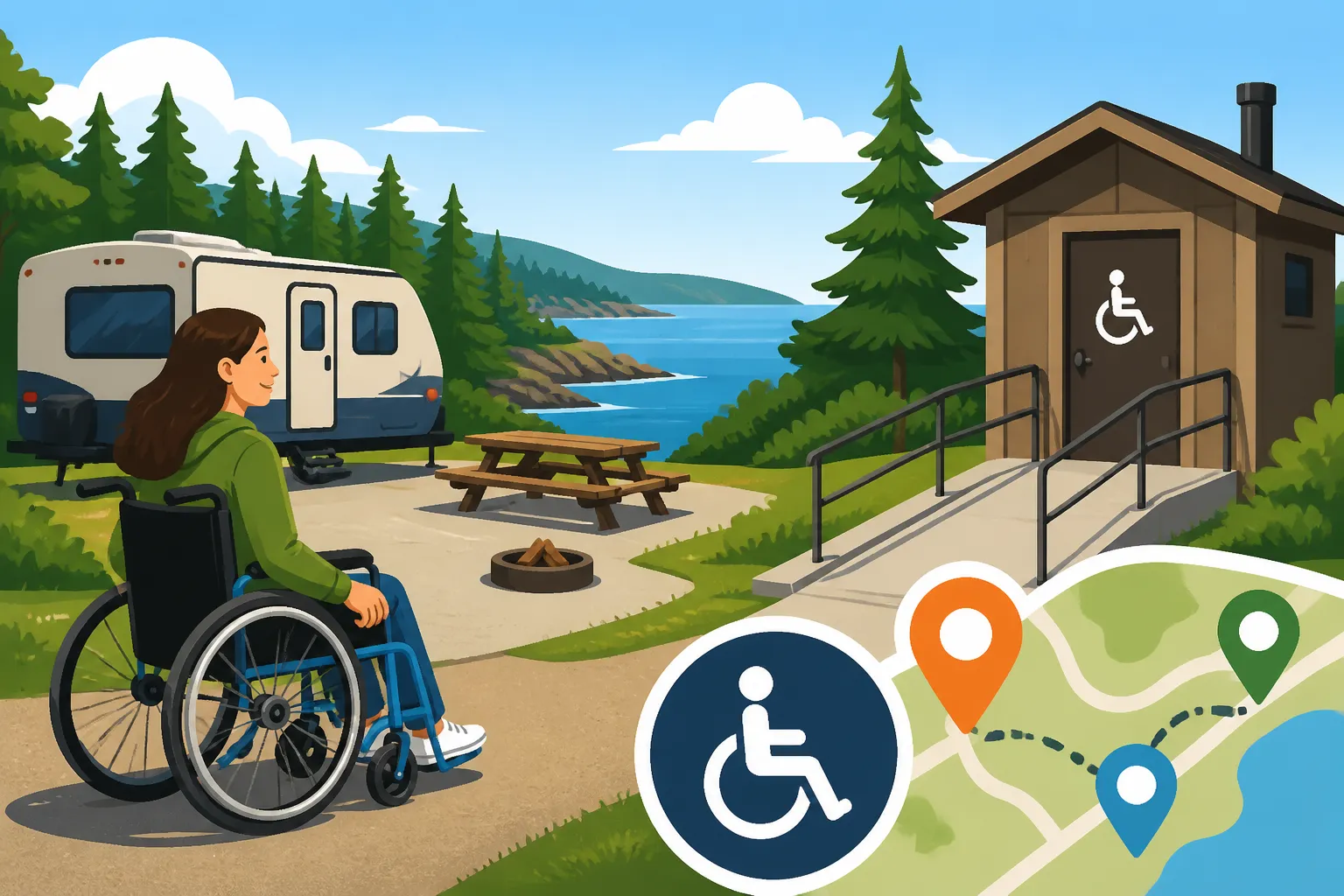
According to the Maine Department of Agriculture, Conservation and Forestry, wheelchair-accessible privies are located at Lily Bay State Park’s beach area, campground entrance, campground loops, and comfort station. That information identifies facilities and their general locations; it does not tell you whether a particular route or campground loop fits your personal requirements. If Lily Bay is on your itinerary, confirm the current details for the area you plan to use.
Restroom questions can be specific without being intrusive. You might ask whether the facility has an accessible entrance, whether the route is paved or otherwise firm, and whether there is room to maneuver inside. If a caregiver will assist, ask about the layout rather than assuming a facility’s label answers that question. If you need a particular type of facility, state that need directly and ask whether it is available at the location you plan to visit.
Campers should also consider the distance and conditions between the campsite and everyday services. A site might be appealing because of its setting, but a longer walk to a restroom, water source or other facility can change how manageable the stay feels. The point is not to choose the site closest to everything by default. It is to understand the trade-off before arrival.
The Maine state park campground rules are another part of planning, particularly when more than one person will share a site or when you need to understand how vehicles and waste are handled. The article Maine State Park Campground Rules: Occupancy, Vehicles and Waste can help you identify those general topics. For the features and layout of a particular site, use the official park information and ask about the exact campsite.
A site may also change in usefulness with weather or seasonal conditions. Rain can affect surfaces and make some paths harder to use. Snow, standing water, maintenance work or a temporary closure can affect routes and facilities. General map information is useful for planning, but it does not guarantee that every route will be in the same condition when you arrive.
When a feature is essential, ask a direct question that can be answered clearly. Instead of asking whether a campground is accessible, explain what you need to do and ask whether the specific site and route support it. If the answer is uncertain, ask whether there is a map, current description or staff contact who can clarify. It is reasonable to decide that a site is not a good fit if the available information does not let you plan confidently.
Read Park Maps as Planning Tools, Not Guarantees
A park map can help you understand how facilities and activity areas relate to each other. It may show campsites, parking, restrooms, trails, beaches, picnic areas, roads and other landmarks. That can help you identify the places to ask about and estimate whether your plans involve one area or several.
The Maine Department of Agriculture, Conservation and Forestry map includes an accessible-site symbol labeled Accessible. Use that symbol as a starting point for finding a marked feature, then confirm what the symbol refers to and whether it matches your needs. A symbol does not necessarily describe the surface, slope, route, distance or current condition of the feature.
When reading a map, begin with the destination you most want to use. Then trace the likely route from where you will arrive. If the map identifies parking and the destination, check whether it also shows a route between them. If it does not, ask whether a route exists and what its surface is like. A map can make the relationship between locations clearer, but it should not be treated as a detailed description of every path.
Maps are often drawn to show the overall layout, not every small change in grade or surface. A line that looks short on a page may still be tiring or difficult to navigate in person. The map may also leave out details that matter to a particular person, such as whether there is a curb, loose gravel, a narrow gate or a place to stop and rest. If those details affect your visit, ask about them specifically.
Use the map to make a short list of questions. For example:
- Which marked feature is intended for the activity I have in mind?
- Where is the nearest parking, and what is the route from there?
- Is the route firm and continuous, or does it change surface?
- Are there slopes, steps, curbs or narrow sections on the route?
- Is there a restroom close to the destination, and can it be reached by the same route?
- Does the map show the feature I need, or should I check another park document?
For a campground, compare the map with the site information before deciding. Look for the campsite’s location relative to roads and facilities, and ask whether the mapped route is open and usable. The map may help you spot a site that appears close to a comfort station, but proximity alone does not establish that the route is convenient or suitable.
For a day visit, use the map to plan where you will park and where you want to spend time. If the outing includes a beach, picnic area and restroom, consider whether these are clustered or spread across the park. A plan that looks easy because the features appear on one map may involve more travel than you expect. Confirm how visitors move between them and whether the route is accessible for your party.
It is also worth checking whether you are looking at a map for the correct part of the park. A state park may have separate maps or information for camping, trails, day-use areas or other facilities. If you find a symbol but cannot tell what it means, ask the park rather than interpreting it based on the symbol alone.
Map information is most useful when combined with current details. Check for notices about construction, temporary closures or other changes before you leave, then ask again if conditions matter to your plans. Checking Maine State Park Closures and Construction Before You Go offers a related overview of why checking current park conditions belongs in trip planning.
Plan Day Visits Around the Whole Route
A day visit can involve more transitions than expected. You may need to move from a vehicle to a picnic area, then to a beach or trail, and later to a restroom. Each transition can affect comfort, energy and timing. Planning those connections can make the outing more predictable.
Start with arrival. Consider how much space you need to get in and out of your vehicle, unload a mobility device or other equipment, and organize belongings. If the park has parking near your intended destination, confirm where it is and whether it is available for the area you want to use. Do not assume that the nearest parking area is beside the facility or that a map symbol tells you how the route feels.
For a beach visit, ask about access from the parking area to the place where you intend to spend time. “Beach access” can refer to reaching a beach area without answering whether a person can travel over the surface, move near the water or find a suitable place to rest. If being on sand or near the water is important, describe that goal and ask what visitors can expect. If the answer depends on conditions, ask how to check those conditions close to your visit.
For a picnic, think about the route to the table and the room around it. Ask whether there is a firm path to the picnic area and whether the table location allows the kind of seating or transfer your party needs. If you expect to bring food, chairs or other equipment, consider how you will carry them from the vehicle. A picnic area that is technically reachable may still involve a challenging surface or a longer walk than expected.
For a trail, ask about the route rather than relying on a trail name or broad description. Useful details may include the surface, grade, obstacles, route length and whether there are places to pause. Those features can determine whether a trail is comfortable and manageable for a particular visitor. If you do not receive enough detail to make a decision, choose a different activity or location rather than assuming that a route will work.
Restrooms should be part of the day plan, even if they are not the main reason for visiting. Check where they are in relation to the activity area and how you will get there. If your plans involve staying for a while, consider whether a restroom is close enough for your needs and whether it is expected to be open. Ask the park about details that are not shown on the map.
A useful day-visit plan includes a primary destination and an alternative. The alternative does not need to be a second park; it could be a different activity area within the same park or a shorter outing if the route or conditions do not work. Choose an option that still makes the trip worthwhile without depending on a feature you have not confirmed.
Before setting out, check current information for closures or changed conditions. The Calling Ahead: Checking Maine State Park Conditions Before a Trip article can help you think through that step. If your visit depends on a particular restroom, route or site, ask about that exact feature rather than only asking whether the park is open.
Once you arrive, take a moment to reassess. The parking space, route, surface or facility may differ from what you expected. If the intended route is blocked or unsuitable, do not feel obliged to continue with the original plan. Use the alternative you prepared, ask park staff about another option, or shorten the visit.
Plan an Accessible Camping Stay With Flexibility
Camping adds routines that a day visit may not require. You will be setting up, storing supplies, moving between the campsite and shared facilities, and managing meals and rest. A campsite that looks workable on a map may not be a comfortable choice once you consider all those tasks.
Begin with your sleeping setup and the space it needs. Think about how you will move around the site, where equipment will go and whether there is room for a mobility device or caregiver support. Ask about the actual ground surface and whether it is level enough for your setup. If the campsite listing uses a general label, request specific details rather than trying to infer the layout from the label.
Then look at the ordinary trips you expect to make. How will you reach a restroom? Where will you get water, if you need it? How far will you travel to leave the campground or reach a shared area? The answers can help you decide whether a more central campsite is important, whether the setting is worth a longer route, or whether another campground would better suit the stay.
An accessible feature at a campground does not necessarily mean every campsite has the same characteristics. Check the individual site and the route to facilities. If you are travelling with an RV, tent or other equipment, explain what you will bring and ask whether the site layout can accommodate it. A site description may focus on the camping unit, while your access needs may depend just as much on the surrounding space.
Allow for arrival and departure tasks as well. You may need to unload gear, position a vehicle, set up a tent or connect equipment. On departure, you will reverse those steps and may be working in different weather or light. If the site surface is difficult in wet conditions, ask about that before you commit to the plan.
A flexible schedule can help. If your group needs time to rest after arrival, avoid building the trip around a packed itinerary. Plan meals and supplies so that you are not forced to make repeated trips across the campground. If you expect to spend most of your time in one park area, consider whether your site choice makes that easier.
It is sensible to prepare a backup for essential facilities. If your visit depends on one particular restroom or route, ask what alternatives are available if it is closed or not usable. You may decide to choose another campground, shorten the stay or change the activity. That is not overplanning; it is a way to reduce the chance of arriving without a workable option.
Rules and site conditions are separate questions. A site may fit your equipment but still be subject to campground requirements about vehicles, occupancy, waste or other matters. Review the applicable rules before the trip, and ask the park if something is unclear. For guidance on the booking process itself, CampWithME Explained: Accounts, Searches and Booking a Maine Campsite covers how campers use the reservation system. For a look at campground map symbols and site labels, see What S, M, L, X and U Mean on Maine Campground Maps.
Do not rely on a campsite description from an earlier trip if the current trip has different needs. Equipment may have changed, a companion may be joining you, or a route may have changed. Recheck the details for the site you intend to use and ask about current conditions, especially if a particular feature is essential.
Ask Clear Questions and Make a Backup Plan
A clear question is more likely to get you a useful answer than a broad request for an accessibility summary. Explain the activity you plan to do and the specific feature you need. You do not need to disclose more personal information than is necessary to describe the practical requirement.
For instance, instead of asking only whether a park is accessible, you could ask whether there is a firm route from a particular parking area to a specific destination. Instead of asking whether a campsite is accessible, you could ask about the surface, slope, available space and route to the restroom for the site you are considering. This gives the person responding a concrete issue to address.
If the answer is vague, follow up with a narrower question. “Is it close?” can mean different things to different people. Ask where the feature is relative to the campsite or parking area, and whether the route changes surface or includes a slope. If the person cannot confirm, ask where to find the most current information or whether another site may be a better fit.
A useful pre-trip checklist might include:
- The exact park area you plan to use.
- The campsite, if you are staying overnight.
- The route from the parking area to your destination.
- The location and condition of the restroom you expect to use.
- Any surface, slope, space or transfer detail that is essential to your visit.
- Whether the feature is expected to be available during your visit.
- A workable alternative if the first choice does not suit your needs.
Keep notes about the answers, especially if you spoke with more than one person or compared multiple sites. Write down the name or description of the facility, the route discussed and any condition that needs confirmation. That makes it easier to compare options and to check the same details again later.
Check for updates close to departure, and confirm again when you arrive if your plan depends on a particular route or facility. Construction, maintenance or weather can affect what you can use. Do not treat an old map or a previous visitor’s description as a guarantee of current access.
If the information you need remains unclear, consider another park or a different part of the same park. A location may be scenic and still not be a practical match for your needs. Choosing a different option is a sound planning decision, not a failure to make the first choice work.
You can also simplify the visit by reducing the number of destinations. Rather than trying to cover many areas, choose the one activity that matters most and confirm the supporting facilities around it. For camping, that might mean prioritizing a campsite with a route and restroom arrangement that works. For a day trip, it might mean a single picnic or beach area instead of moving between several locations.
The most reliable plan is not necessarily the one with the most detail. It is the one that identifies what must work, verifies those essentials and leaves room to adjust. If the park cannot confirm a detail that is critical to your visit, factor that uncertainty into your decision before travelling.
Frequently Asked Questions
Does an accessible-site symbol mean the whole park is accessible?
No. A symbol identifies a marked feature, but it does not describe every route, facility or activity in the park. Confirm what the symbol refers to and ask whether the route and conditions suit your needs.
What should I ask about an accessible campsite?
Ask about the specific site’s surface, slope, available space and route to the facilities you expect to use. Also check the route from the campground entrance and any parking area relevant to your stay.
Are accessible privies available at Lily Bay State Park?
The Maine Department of Agriculture, Conservation and Forestry identifies wheelchair-accessible privies in the beach area, campground entrance, campground loops and comfort station. Confirm current details and whether the location you plan to use fits your needs.
What if I cannot confirm an important feature before I go?
Consider a different site or park, or choose a backup activity that does not depend on the uncertain feature. Check again before leaving and when you arrive if conditions may have changed.
Sources
- Maine Department of Agriculture, Conservation and Forestry — Lily Bay State Park Trail Conditions & Activities: Maine DACF (checked November 23, 2026)
Disclaimer
This article is for general informational purposes only and does not constitute professional advice. Laws, prices and regulations vary by location and change over time. Consult a qualified professional for guidance on your specific situation. Maine Camping & RV is not a government agency and is not affiliated with any government agency.