Paying to Enter a Maine State Park: Fees, Booths and Exemptions
A Maine state park visit can involve a day-use charge, a pass, an exemption, or a payment station with no staff at the entrance. The tricky part is knowing which applies to your trip before you arrive. This guide explains how to check the current charge, what to expect at staffed and self-service entrances, and how to avoid assuming that an exemption or campsite reservation covers more than it does.
What a state park entry fee covers
An entry fee is a charge for visiting a park for day use. It is separate from the cost of camping, and it may be different from a pass that covers admission at participating locations. Treat these as separate questions when planning: Are you paying to enter? Are you staying overnight? Do you have a pass or qualify for an exemption?
The Maine Department of Agriculture, Conservation and Forestry says fees vary by park and amenities and are subject to change at any time. That means a figure you found in an old trip note, a social media post, or a past visit may not be a reliable guide to the current charge. Check the official park information before leaving, especially if you are choosing between destinations based on cost.
Amenities are part of why charges can differ, but do not assume that a certain facility automatically means a particular fee. A beach, picnic area, or other feature may matter to a park’s published fee information, but the official listing is the place to confirm what applies to your visit. For a broader look at how charges are counted, see Per Person or per Car? How Maine State Park Entry Fees Are Counted.
It also helps to distinguish admission from the cost of activities or services. An entry fee is not necessarily a payment for every service you might use, and paying for camping is not automatically the same as paying for a separate day visit. Confirm the terms that apply to your specific park and trip rather than treating every park charge as interchangeable.
When comparing options, check the same details for each park:
- The current day-use admission information.
- Whether a pass is accepted for that location and visit.
- Whether you may qualify for an exemption.
- How payment is handled at the entrance.
- Whether your visit is day use or connected to an overnight stay.
- Whether the park has a separate notice about access, operating conditions, or fees.
This approach is useful when two parks seem similar but have different amenities or admission arrangements. It also keeps a single fee question from overshadowing other practical decisions, such as whether the park fits your group, whether there is a suitable picnic area, or whether an overnight campground is available. The current fee details, rather than a general expectation about Maine parks, should guide the final choice.
Check the current charge before you leave
The most dependable way to plan is to start with the official information for the park you intend to visit. Look for the entry or day-use section, read any notes about passes and exemptions, and check for a notice that could affect access. If the park publishes more than one fee category, make sure you are looking at the one that matches your visit.
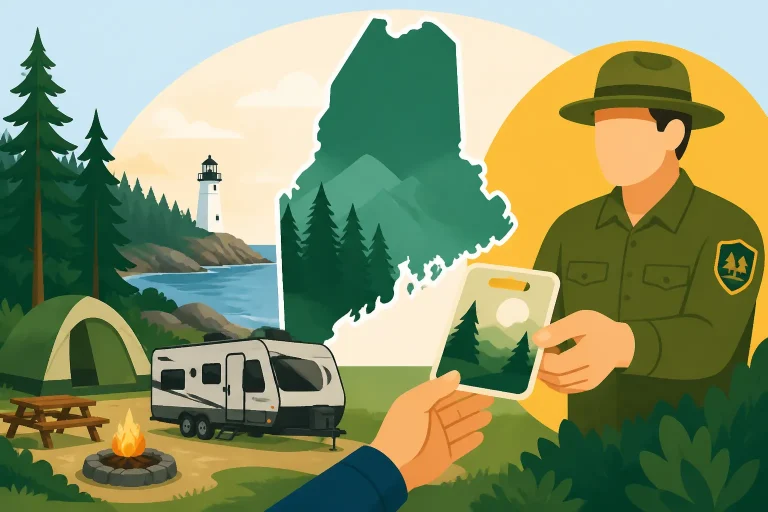
The Maine Department of Agriculture, Conservation and Forestry explains that park fees are collected at the booth by staff or through self-service stations. That gives you two possible payment arrangements, but it does not tell you which arrangement you will encounter at a particular entrance on a particular day. Do not plan on finding a staffed booth, or on being able to use a particular payment method, unless the official park information confirms it.
If you cannot find a current fee amount or are unsure whether a pass or exemption applies, check the official website for current park details and contact information. A quick check before departure is more useful than trying to resolve an unclear fee after you have driven to the entrance. For help locating up-to-date pass information, see Finding the Current Price of a Maine State Park Pass.
A practical pre-trip check
Before you set out, work through these questions:
- Which park are you visiting? Confirm the exact destination rather than relying on a similar park name or an old map.
- Is your visit day use or overnight? Check admission separately from campsite charges.
- Do you plan to use a pass? Verify that the pass applies to the park and type of visit.
- Could an exemption apply? Read the current eligibility description and note any conditions.
- How will you pay if you owe a fee? Check the official information rather than guessing what the entrance accepts.
- Could the entrance arrangement be different from what you expect? Be prepared for either staff at a booth or a self-service station.
- Has anything changed? Check again close to departure if your plans were made well in advance.
This is not a demand to research every detail of a simple outing. It is a way to focus on the few details most likely to affect whether you can enter smoothly and pay the right amount. If you have already visited a park, the previous trip can help you know what questions to ask, but it cannot guarantee that the fee, payment arrangement, or eligibility terms remain the same.
For current figures, use the park’s official information rather than trying to reconstruct a total from an old receipt. If the fee is not stated clearly, look for the official contact information and ask about the exact date and type of visit you have in mind. That is especially helpful when your group includes people who may qualify for an exemption or when you are combining a day visit with an overnight reservation.
Paying at a booth or self-service station
At a staffed booth, follow the instructions from the park staff and explain any pass or exemption you expect to use. If something about your eligibility is unclear, ask before completing the transaction. It is easier to address a question at the entrance than to assume a pass or exemption will be recognized later.
At a self-service station, read the posted directions carefully and follow the process provided there. Take a moment to make sure you are using the station for the correct park and visit. If instructions refer to a pass, exemption, or payment option you do not understand, do not substitute your own interpretation; use the park’s official information to clarify the requirement.
Do not assume all entrances use the same equipment or process. A station may have instructions that differ from a staffed booth, and the presence of a self-service option does not establish which payment methods are accepted. Confirm current instructions before relying on cash, a card, a digital payment, or any particular way of proving eligibility. Where the official information is not specific, arrive prepared to follow the posted directions and seek clarification through official channels.
If no staff member is at the entrance
An unattended entrance does not necessarily mean admission is free. The Maine Department of Agriculture, Conservation and Forestry, Bureau of Parks and Lands, says day-use fees remain payable during fall and winter at entry self-service stations. Follow the station’s instructions rather than treating a closed booth as a waiver.
If you are unsure whether a station applies to your visit, read its notice and check the park’s official information. Do not assume you can pay later, leave payment somewhere other than the designated station, or return to the entrance after beginning your visit. The park’s stated process is the one to follow.
For a more focused explanation of unattended entry points, see No One at the Booth? Paying at a Maine State Park Self-Service Station. The useful takeaway is simple: plan for the possibility that payment is handled without a staff member, and check the posted instructions when you arrive.
Keep the payment question separate from access questions
Payment and access are related, but they are not always the same question. A park could have a payment station and still have other conditions that affect your visit. Likewise, paying an entry charge does not tell you whether a particular facility is open or whether a specific activity is available. Check the current park information for both the payment process and the conditions relevant to your plans.
If you are travelling with a group, make sure the person responsible for payment understands the arrangement before reaching the entrance. One person can check whether a pass or exemption applies, while another confirms the park and its current instructions. Avoid relying on someone else’s recollection of a previous visit when the eligibility or payment details are important to your trip.
Exemptions and passes: verify what applies
An exemption is not the same thing as a general discount, and a pass is not automatically accepted everywhere or for every kind of visit. Check the exact eligibility language for the exemption or pass you plan to use. Look for the park or location covered, the visit type covered, and any requirements for the person claiming it.
The Maine Department of Agriculture, Conservation and Forestry, Bureau of Parks and Lands, says Maine residents aged 65 and older receive free day-use admission. If you think this applies to your visit, confirm the current terms and what the park asks you to provide to establish eligibility. Do not assume that the same exemption covers camping, other charges, or every location with a different admission arrangement.
For the eligibility details, see Free State Park Admission for Maine Seniors: Who Qualifies. If you are planning around a pass instead, The Maine State Park Pass: Day Entry, Participating Parks, Exceptions is a useful place to check which locations and visits are covered. The point is to match the benefit to the trip, not just to identify that a pass or exemption exists.
Make an eligibility check specific
When checking an exemption, be precise about who is eligible and what the exemption covers. A general description such as “senior admission is free” may leave out a residency condition or the distinction between day use and overnight costs. Use the full current eligibility wording, and ask the park if an important detail is not clear.
When checking a pass, confirm that the park participates and that the planned visit falls within the pass terms. A pass may have exceptions, so do not use a statewide-sounding name as proof that every state park entrance is covered. The relevant question is whether the pass applies to this park and this visit.
If a group includes people with different eligibility, avoid assuming that one person’s exemption covers everyone travelling with them. Confirm how the park applies the benefit to the party and what the entrance process requires. If there is more than one possible way to qualify, ask which one is relevant before arriving.
Keep any required proof accessible, but do not assume what documents are required unless the official information says so. The park’s current instructions determine what it will accept. If your qualification depends on residency, age, or another condition, verify how the park expects that condition to be established rather than relying on an informal explanation from a third party.
Check exceptions before choosing a destination
A trip plan built around a pass can become frustrating if the chosen park is an exception. Before finalizing your route, check the pass information for every park you may visit, including a stop added on the way. A pass that works at one destination should not be assumed to work at another.
Some locations have distinct entry arrangements, so read the exceptions rather than only the pass overview. Baxter State Park, Swan Island and Peacock Beach: Pass Exceptions can help when one of those destinations is on your itinerary. If your route includes multiple parks, verify each one on its own instead of treating admission at the first stop as proof of coverage for the rest.
If you do not have enough information to determine whether a benefit applies, budget and plan as though you may need to follow the park’s standard payment process, then confirm before departure. This does not mean a charge will necessarily apply; it prevents an unverified assumption from becoming the basis of the trip.
Fall and winter visits still need a payment plan
A quieter season can change the experience of a park visit, but it does not automatically remove the day-use charge. The Maine Department of Agriculture, Conservation and Forestry, Bureau of Parks and Lands, states that park day-use fees still apply and are payable at entry self-service stations during fall and winter.
That matters when you arrive and find no staffed booth. Do not treat the absence of staff as proof that admission is free. Check the official information before leaving, then read the station’s posted directions when you arrive. If the park has a seasonal notice, use it to confirm the payment process and any other relevant access conditions.
For a closer look at off-season admission, see Off-Season Entry Fees at Maine State Parks: Still Due?. If you are also unsure when a park is open to visitors, check When Do Maine State Parks Open and Close Each Day?. Entry fees and hours are separate details; checking one does not answer the other.
Plan for a self-service entrance
For a fall or winter outing, build in a moment to read the entrance instructions before continuing into the park. Keep the official fee information available, and be ready to follow the designated payment process if the station indicates a charge is due. If a pass or exemption may apply, have the relevant information ready and follow the instructions for claiming it.
Do not make assumptions based only on the season, the weather, or how busy the entrance looks. A quiet entrance may still have a payment procedure. A closed booth may mean the station is self-service rather than that the fee has been suspended. The park’s posted instructions and current official information are the right references.
Seasonal conditions can also affect facilities or access separately from admission. If your plans depend on a particular beach, picnic area, or other feature, check whether it is available for your visit. A payment arrangement does not promise that every amenity is open, and a seasonal facility notice does not necessarily explain admission. Check both if both affect your plans.
Keep entry fees separate from camping and other trip costs
A state park camping reservation and day-use admission are distinct planning questions. Before assuming that an overnight booking includes admission, check the terms that apply to the campsite and the park. Does Your Maine Campsite Fee Already Cover Day Entry? addresses that question directly. Use the answer for the specific booking and park rather than generalizing from a previous campground stay.
Likewise, do not treat a state park pass as payment for a campsite unless the official pass terms say so. Admission and overnight stays can be handled differently. If you are booking a campsite, review the reservation details for the costs and conditions that apply, then separately confirm whether you need to pay an entrance fee for any day-use visit.
A simple way to organize your budget is to make separate lines for:
- Day-use admission, if it applies.
- Any pass you plan to use or purchase.
- The campsite charge, if you are staying overnight.
- Other services or activities whose costs the park lists separately.
This is a planning checklist, not a claim that every visit has all of these charges. Some items may not apply, and the park’s current information determines what is due. The benefit of separating them is that it prevents an overnight fee, a pass, or an exemption from being mistaken for a different kind of payment.
When you are planning a multi-park outing, confirm the entry arrangement for each stop. A camping reservation at one park does not settle admission at a second park. A pass accepted at one destination does not prove acceptance at another. If you add a stop after leaving home, check the new park’s current details before changing your route.
When to contact the park
Use official park information when a key detail is missing, contradictory, or important to your plans. That includes uncertainty about whether a pass applies, how an exemption is claimed, what payment methods are accepted, or whether an entrance uses a staffed booth or self-service station. Find current contact details through the official website rather than relying on an old listing.
When asking, describe the park, the date of your planned visit, whether you are visiting for day use or camping, and the pass or exemption you expect to use. Those details make it easier to get an answer that fits your situation. If your plans may change, ask whether the answer depends on the visit type or the particular entrance.
If you are comparing parks, use the same questions for each one. This makes the cost comparison more useful and keeps one park’s arrangement from being incorrectly applied to another. It is also a good time to check whether the park’s amenities and access fit the trip, rather than choosing solely on an old or incomplete fee figure.
A simple way to avoid entrance surprises
Before the trip, confirm the current entry information for the exact park. Decide whether you are relying on a pass or exemption, and verify that it applies to that location and visit. If the park’s payment method is unclear, use the official website to find current details or contact information.
At the entrance, follow the posted instructions. If staff are present, ask about any uncertain eligibility before paying. If there is a self-service station, read its directions and use the process it specifies. Do not assume that no staff, a quiet season, or a previous visit means a fee is not due.
For an overnight trip, check admission separately from the campsite booking. For a day visit, check whether the charge changes by park or amenities. For a pass or exemption, check the specific coverage and any exceptions. These are small checks, but together they prevent the most common planning mistake: assuming that a fee, pass, or payment method works the same way at every Maine state park.
The most reliable plan is not to memorize one statewide expectation. It is to verify the current information for the park you will visit, keep admission separate from other trip costs, and be prepared to use the payment process posted at the entrance. That works whether you are going for a short day visit, adding a park to a road trip, or arriving at a campground during a season when the booth may not be staffed.
Frequently Asked Questions
Do Maine state parks always have a staffed entrance booth?
No single entrance arrangement should be assumed for every visit. Park fees may be collected by staff or through self-service stations. Check the park’s current information and follow the instructions posted at the entrance.
Are Maine state park day-use fees due in fall and winter?
Season alone is not a reason to assume admission is free. Check the park’s information and look for the entry self-service station instructions when you arrive.
Can a pass or exemption cover a campsite?
Do not assume it does. Confirm the terms for the specific pass or exemption, and check campsite charges separately from day-use admission.
How can I confirm a current fee or payment method?
Use the official park information for the destination and look for current contact details there if something is unclear. Fees and payment arrangements can change, so an old receipt or past visit is not a reliable substitute.
Sources
- Maine Department of Agriculture, Conservation and Forestry, Bureau of Parks and Lands — State Parks: About Us: Bureau of Parks and Lands: Maine DACF (checked November 23, 2026)
- Maine Department of Agriculture, Conservation and Forestry, Bureau of Parks and Lands — outdoors-in-maine.pdf?utm_source=openai (checked November 23, 2026)
- Maine Department of Agriculture, Conservation and Forestry — Maine State Park Campground Reservations (checked November 23, 2026)
Disclaimer
This article is for general informational purposes only and does not constitute professional advice. Laws, prices and regulations vary by location and change over time. Consult a qualified professional for guidance on your specific situation. Maine Camping & RV is not a government agency and is not affiliated with any government agency.